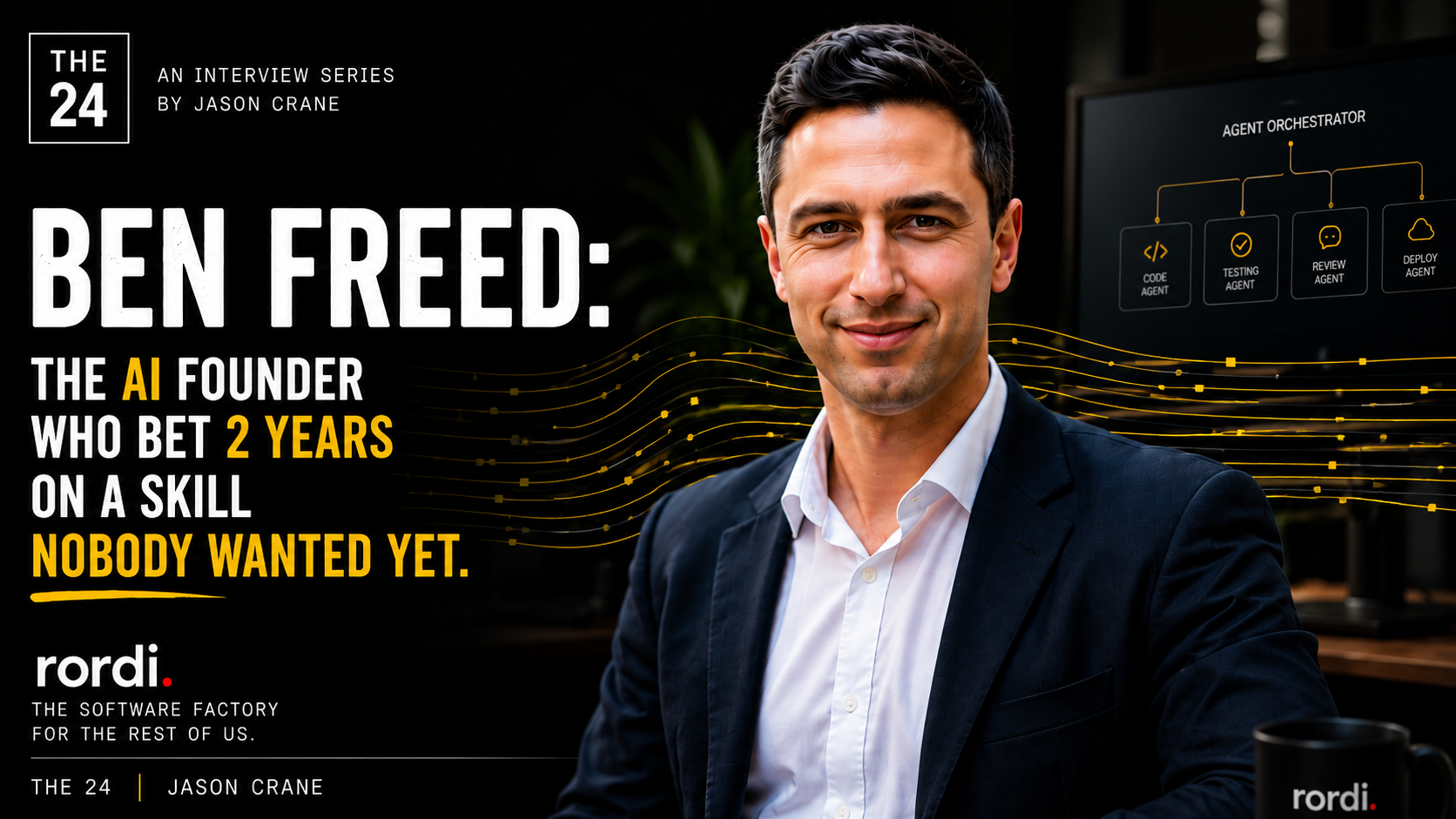
THE 24 · FEATURED GUEST: BEN FREED, FOUNDER OF RORDI
The 24: Ben Freed Traded Ten Years of Houses for a Bet He Can’t Hedge
The 24 is CNA Search’s interview series on the first 24 months after a company’s defining moment. Host: Jason Crane.
Two years ago, Ben Freed is running three construction companies at once and staring down a birthday. “I’m about to hit 40. I was like, I need some explosive wealth in my life or I’m not gonna make it.” He isn’t a trader. He isn’t a crypto guy. By his own account he has no luck investing. What he has is a decade of building physical things and a habit of building internal tools for his own companies because he never learned to code. The math points one direction: tech.
The company count that cost him
The burnout doesn’t come from one business. It comes from multiplying them. “I had one company and then I thought it would be a great idea to start two more,” he says, because design build “is really like starting an architecture firm and a construction firm.” He runs all three until there’s nothing left to run on.
The deeper problem isn’t stamina. It’s the market itself. “The friction for building what I wanted, what my vision was in construction, was just too high. I tried it so many different ways in different times. It was just not gonna happen.” He could do a whole podcast series, he says, on why US construction is doomed and why the startups around it have failed. He doesn’t relitigate the exits. He names the ceiling and moves.
Some markets don’t reward vision. They tax it.
The bet before the wave
The pivot lands before agentic coding takes off. “I started prompting back in 2024 and was just hooked immediately.” The gap between prompting for fun and shipping production systems is wide then, so he spends two years closing it: a consulting stint as a chief AI officer, a construction space product he takes on reluctantly, and endless tooling built around coding agents. The timing catches up to him rather than the other way around. “The skills that I’ve been working on for two years are basically what everybody wants right now.”
The bet hasn’t fully paid off yet, and he says so. But the skills compounded while the market decided.
What breaks first
Two months into Rordi, his software factory product, the first thing that breaks isn’t the technology. It’s the buyer. “I think people don’t really know what they want with AI.” Companies buy the tools and then stall, because “there’s no such thing as pure off the shelf with something like this. And I think a lot of people are realizing that.”
His answer is an opinionated structure: the first project maps a product’s entire ontology, customers, features, initiatives, the vision layer, into a living document he calls Canon, tested and updated as the product ships. The founder gets something unexpected out of the exercise. “You end up getting insight into your own ideas in a way that you haven’t before, because it’s actually in a framework that has to be validated against.”
The first deliverable isn’t code. It’s the founder’s own thinking, finally written down where it can be checked.
The hire he refuses to make
Ask about his hiring plan and the answer is blunt. “I’m gonna hire as little as possible. The roles are too hard to hire for.” He watches job posts asking for full stack engineers with ten years of experience, AI native, in office, “for like a 180K,” and asks the obvious question: “How are you gonna find these people and compete with the big labs?”
The role he will eventually hire for doesn’t exist on most org charts yet. Not a sales engineer, not a forward deployed engineer, but both collapsed into one. “The forward deployed sales and engineers in one is really, I think, gonna be where it’s at. You go in, you sell, you set it up, you support.” Not a utility player jumping between positions. “The through line is a new type of role.” What he screens for isn’t a stack. “It’s that agency, I think, that is gonna be where it’s at.”
When the technical side gets cheaper, the person who holds the context gets more expensive.
Month two, and the next ten
Right now Rordi has one employee, and the product is its own first customer. “Definitely, it’s dogfooding. I’m building the systems that help me promote my own company.” The plan for the next ten months: onboard teams willing to work through the rough edges, then build out from initial revenue or investment. “By the end of the summer, have an engine really roaring.”
Asked whether a good product creates the longevity he’s after, Freed gives the most honest answer in the interview.
“Hopefully.”
Freed’s whole story, three companies down to one, a role he won’t fill until it’s the right shape, a bet staked on two years of unfashionable skill building, is a reminder that talent and leadership decisions are value creation decisions, made long before the market prices them.
That’s The 24. If something in Ben’s story sounds like your first 24 months, reply and tell us, or connect with Jason Crane on LinkedIn.